Quem namorou Catarina Henriqueta de Balzac d’Entragues?
Henry IV of France namorou Catarina Henriqueta de Balzac d’Entragues de ? a ?.
Catarina Henriqueta de Balzac d’Entragues
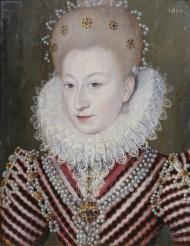
Catarina Henriqueta ou Catherine Henriette de Balzac d'Entragues (1579-1633), Marquesa de Verneuil.
A ela, depois da morte de Gabrielle d'Estrées, Henrique IV teria prometido casamento: era filha de Marie Touchet (amante do rei Carlos IX), e de seu marido François de Balzac d'Entragues; sendo assim meia irmã do Conde de Auvergne Carlos de Valois (1573-1650), Duque de Angoulême em 1619, filho de Maria Touchet e do rei.
Teria feito cenas ao rei por ocasião de seu casamento com Maria de Médicis, entrando na conspiração do marechal de Biron em 1606 mas retomando os favores reais em 1608. Suspeita-se de seu envolvimento nas intrigas espanholas que precederam a morte do Rei.
Com Catarina Henriqueta o famoso diálogo, em que ela teria reclamado do cheiro corporal do rei:
- “Vous avez de la chance d’être roi car, en vérité, Sire, vous puez comme une charogne.»
- «Effectivement», lui repondit il, »j’ai le gousset qui sent un peu fin.»
Ver seus filhos em Henrique IV.
Leia mais...Henry IV of France

Henry IV (French: Henri IV; 13 December 1553 – 14 May 1610), also known by the epithets Good King Henry (le Bon Roi Henri) or Henry the Great (Henri le Grand), was King of Navarre (as Henry III) from 1572 and King of France from 1589 to 1610. He was the first monarch of France from the House of Bourbon, a cadet branch of the Capetian dynasty. He pragmatically balanced the interests of the Catholic and Protestant parties in France, as well as among the European states. He was assassinated in Paris in 1610 by a Catholic zealot, and was succeeded by his son Louis XIII.
Henry was baptised a Catholic but raised as a Huguenot in the Protestant faith by his mother, Queen Jeanne III of Navarre. He inherited the throne of Navarre in 1572 on his mother's death. As a Huguenot, Henry was involved in the French Wars of Religion, barely escaping assassination in the St. Bartholomew's Day massacre. He later led Protestant forces against the French royal army. Henry inherited the throne of France in 1589 upon the death of Henry III, his distant cousin. Henry IV initially kept the Protestant faith (the only French king to do so) and had to fight against the Catholic League, which refused to accept a Protestant monarch. After four years of military stalemate, Henry converted to Catholicism, reportedly saying that "Paris is well worth a Mass". As a pragmatic politician (politique), he promulgated the Edict of Nantes (1598), which guaranteed religious liberties to Protestants, thereby effectively ending the French Wars of Religion.
An active ruler, Henry worked to regularize state finance, promote agriculture, and encourage education. He began the first successful French colonization of the Americas. He promoted trade and industry, and prioritized the construction of roads, bridges, and canals to facilitate communication within France and strengthen the country's cohesion. These efforts stimulated economic growth and improved living standards.
While the Edict of Nantes brought religious peace to France, some hardline Catholics and Huguenots remained dissatisfied, leading to occasional outbreaks of violence and conspiracies. Henry IV also faced resistance from certain noble factions who opposed his centralization policies, leading to political instability. His main foreign policy success was the Peace of Vervins in 1598, which made peace in the long-running conflict with Spain. He formed a strategic alliance with England. He also forged alliances with Protestant states, such as the Dutch Republic and several German states, to counter the Catholic powers. His policies contributed to the stability and prominence of France in European affairs.
Leia mais...