Quem namorou Alexander the Great?
Hephaestion namorou Alexander the Great de ? a ?.
Barsine namorou Alexander the Great de ? a ?.
Cleophis namorou Alexander the Great de ? a ?.
Bagoas namorou Alexander the Great de ? a ?.
Campaspe namorou Alexander the Great de ? a ?.
Alexander the Great

Alexander III of Macedon (Ancient Greek: Ἀλέξανδρος, romanized: Aléxandros; 20/21 July 356 BC – 10/11 June 323 BC), most commonly known as Alexander the Great, was king of the ancient Greek kingdom of Macedon. He succeeded his father Philip II to the throne in 336 BC at the age of 20, and spent most of his reign conducting a lengthy military campaign throughout Asia and Egypt. By the age of 30, he had created one of the largest empires in history, stretching from Greece to northwestern India. He was undefeated in battle and is widely considered to be one of history's greatest and most successful military commanders.
Born in Pella, Macedon, Alexander was tutored by philosopher and polymath Aristotle until the age of 16. In 335 BC, shortly after assuming the throne of Macedon, he launched a campaign in the Balkans and reasserted control over Thrace and parts of Illyria before marching on the city of Thebes, which was subsequently destroyed. Alexander then assumed leadership of the League of Corinth, created by his father.
With this authority over all Greeks he launched a pan-Hellenic invasion of the Persian Achaemenid Empire in 334 BC, and with it began a series of campaigns which lasted for ten years. Following his conquest of Asia Minor and a series of decisive battles, particularly at Issus and Gaugamela, the power of the Achaemenid Empire was broken. He subsequently overthrew Darius III and conquered the Achaemenid Empire in its entirety. After the fall of Persia, the Macedonian Empire held a vast swath of territory between the Adriatic Sea and the Indus River. Alexander endeavored to reach the "ends of the world and the Great Outer Sea" and invaded India in 326 BC, achieving an important victory over Porus, an ancient Indian king of present-day Punjab, at the Battle of the Hydaspes. Facing mutiny from troops, he was eventually forced to turn back at the Beas River, and later died in 323 BC in Babylon, Mesopotamia, the city which he had planned to make the capital of his empire, while on his return to Greece. Alexander's death put an end to his planned invasion of Arabia.
In the years following his death, a series of civil wars broke out across the Macedonian Empire, eventually leading to its disintegration at the hands of the Diadochi. Alexander's death marks the conventional beginning of the Hellenistic period. Through his conquests, he built a legacy that includes the cultural diffusion and syncretism, which gave rise to Greco-Buddhism and Hellenistic Judaism. He founded more than twenty cities, with the most prominent being the city of Alexandria in Egypt. Alexander's establishment of Greek colonies and the spreading of Greek culture led to Hellenistic civilization becoming a major force in the ancient world, influencing regions as far east as the Indian subcontinent. The Hellenistic period developed through the Roman Empire into modern Western culture; the Greek language became the lingua franca of the region and was the predominant language of the Byzantine Empire until its collapse in 1453 AD.
Alexander became a legendary hero similar to Achilles, featuring prominently in the historical and mythical traditions of both Greek and non-Greek cultures. His military achievements and successes in battle made him the touchstone against which many later military leaders would judge themselves. His tactics remain a significant subject of study in military academies worldwide. Legends of Alexander's exploits were coalesced into the 3rd century Alexander Romance which, in the premodern period, went through over one hundred recensions, translations, and derivations and was translated into almost every European vernacular and every language of the Islamic world. After the Bible, it was the most popular form of European literature.
Leia mais...Hephaestion
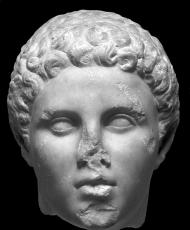
Heféstio Amíntoro (356 a.C. — outono de 324 a.C.), era filho de Amíntor, aristocrata macedônio. Foi educado juntamente com Alexandre III da Macedónia, tendo tido também Aristóteles como professor. Sabe-se que, entre os trabalhos do filósofo, há um livro perdido de cartas a Heféstio.
Acompanhou Alexandre na sua campanha asiática desde o princípio, combatendo como general na cavalaria de elite. Quando passaram pela cidade de Troia (hoje, na Turquia), Alexandre foi honrar a sagrada tumba do herói Aquiles, levando Heféstio consigo para honrar a de Pátroclo (no século V a.C. criou-se o mito que esses dois heróis da Ilíada foram amantes, embora Homero nada tenha deixado explícito). O historiador Arriano de Nicomédia, uma das mais respeitadas fontes sobre Alexandre, escreveu que Heféstio foi a pessoa a quem Alexandre mais amou em toda sua vida.
Após a batalha de Gaugamela (norte da Mesopotâmia), os dois foram inspecionar a tenda da família real. Um dos episódios mais conhecidos sobre Heféstio foi quando ambos conheceram Estatira e Sisigambis, respectivamente filha e mulher do rei Dario III. Segundo o historiador Cúrcio Rufo, a rainha mãe olhou para os dois homens mas prostrou-se perante Heféstio, que era mais alto e bonito e, segundo a lógica persa, quem mais chamava a atenção era o rei. Ao ser alertada pelo seu engano, ia prostrar-se novamente perante a Alexandre, mas este a levantou e a corrigiu dizendo: "Não te preocupes rainha mãe, não cometeste erro nenhum. Ele também é Alexandre".
Por ser um dos poucos em quem Alexandre confiava, além de sua autoridade militar, também recebeu amplos poderes políticos.
Antes da invasão da Índia e cruzar o Indocuche, no atual Afeganistão, Alexandre o nomeou ministro, reconhecendo como segundo homem do seu reino. Quando Alexandre casou-se com a princesa Estatira II da Pérsia, filha do rei Dario, deu a Heféstio por esposa a jovem princesa Dripetis, de modo que passaram a ser cunhados.
No outono de 324 a.C., no retorno após terem conquistado o Vale do Indo, quando o exército macedônio se estabelecia em Ecbátana para passar o inverno, Heféstio caiu doente e não se adaptou à dieta rígida. Desconsiderou as prescrições médicas, comeu frango assado, bebeu vinho arrefecido e morreu. Os sintomas apontaram febre tifoide, mas suspeitou-se de envenenamento.
Independente da causa de sua morte, os historiadores dizem que Alexandre ficou louco de dor, cortando os próprios cabelos e as crinas dos cavalos do exército, mandou crucificar Gláucias, o médico que havia atendido Heféstio. Até os toques de flautas ficaram proibidos no acampamento. Após massacrar a revoltosa tribo dos Cosseanos, numa contenda intitulada Sacrifício Fúnebre de Heféstio, Alexandre celebrou fabulosos jogos funerais em homenagem e determinou que se deveriam adorar Heféstio como um herói divino. Guardou um luto rígido durante meses e, pouco tempo depois, ainda estava construindo um esplêndido monumento funerário em honra ao amante, quando o próprio Alexandre morreu em Babilônia.
Após a morte de Heféstio, seu cargo foi assumido por Pérdicas, o comandante da cavalaria.
A Carta 24 de Diógenes de Sinope, ainda que trazida a público apenas no primeiro ou segundo século da era cristã, reflete provavelmente os boatos dos últimos dias de Alexandre – expressa que o filósofo repreendeu o conquistador, dizendo: "Se queres ser bom e formoso (kalos kai agathos), tira esse trapo que tens sobre tua cabeça e vem conosco. Mas não serás capaz de vir, dado que estás preso pelas coxas de Heféstio".
Leia mais...Alexander the Great
Barsine
Barsina (ca. 363 a.C. — 309 a.C.) foi amante de Alexandre, o Grande.
Leia mais...Alexander the Great
Cleophis

Cleophis (Sanskrit: Kripa ) was an Assacani queen and key figure in the war between the Assacani people and Alexander the Great. Cleophis was the mother of Assacanus, the Assacanis' war-leader at the time of Alexander's invasion in 326 BCE. After her son's death in battle, Cleophis assumed command and negotiated a settlement that allowed her to retain her status. Later accounts claim Cleophis had a son by Alexander, a notion dismissed by historians.
The Assacani (called Ashvakas in Sanskrit, from the word Ashva, meaning "horse") were an independent people who lived in parts of the Swat and Buner valleys in ancient Gandhara. These highlanders were rebellious, fiercely independent clans who resisted subjugation.
Leia mais...Alexander the Great
Bagoas

Bagoas (altpersisch Bagoi; altgriechisch Βαγώας; † nach 324 v. Chr.) war ein Günstling am persischen Königshof und im Gefolge Alexanders des Großen im 4. vorchristlichen Jahrhundert. Er ist nicht zu verwechseln mit dem gleichnamigen Hofminister.
Leia mais...Alexander the Great
Campaspe

Campaspe (d'après Claude Élien) ou Pancaspé (d'après Pline l'Ancien (latin : Panscapen) passe pour avoir été une maîtresse d'Alexandre le Grand et le modèle du peintre Apelle. Son existence est probablement une légende, elle est surtout connue par une anecdote apocryphe de Pline l'Ancien qui a été le sujet de nombreuses représentations artistiques.
Leia mais...