Quem namorou Voltaire?
Émilie du Châtelet namorou Voltaire de ? a ?. A diferença de idade foi de 12 anos, 0 meses e 26 dias.
Voltaire

François-Marie Arouet (French: [fʁɑ̃swa maʁi aʁwɛ]; 21 November 1694 – 30 May 1778), known by his pen name Voltaire (, US also ; French: [vɔltɛːʁ]), was a French Enlightenment writer, philosopher (philosophe), satirist, and historian. Famous for his wit and his criticism of Christianity (especially of the Catholic Church) and of slavery, Voltaire was an advocate of freedom of speech, freedom of religion, and separation of church and state.
Voltaire was a versatile and prolific writer, producing works in almost every literary form, including plays, poems, novels, essays, histories, and even scientific expositions. He wrote more than 20,000 letters and 2,000 books and pamphlets. Voltaire was one of the first authors to become renowned and commercially successful internationally. He was an outspoken advocate of civil liberties and was at constant risk from the strict censorship laws of the Catholic French monarchy. His polemics witheringly satirized intolerance and religious dogma, as well as the French institutions of his day. His best-known work and magnum opus, Candide, is a novella that comments on, criticizes, and ridicules many events, thinkers and philosophies of his time, most notably Gottfried Leibniz and his belief that our world is of necessity the "best of all possible worlds".
Leia mais...Émilie du Châtelet
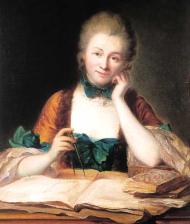
Gabrielle Émilie Le Tonnelier de Breteuil, Marquise du Châtelet (French: [emili dy ʃɑtlɛ] ; 17 December 1706 – 10 September 1749) was a French mathematician and physicist.
Her most recognized achievement is her philosophical magnum opus, Institutions de Physique (Paris, 1740, first edition; Foundations of Physics). She then revised the text substantially for a second edition with the slightly modified title Institutions physiques (Paris, 1742). It circulated widely, generated heated debates, and was translated into German and Italian in 1743. The Institutions covers a wide range of topics, including the principles of knowledge, the existence of God, hypotheses, space, time, matter and the forces of nature. Several chapters treat Newton's theory of universal gravity and associated phenomena. Later in life, she translated into French, and wrote an extensive commentary on, Isaac Newton's Philosophiæ Naturalis Principia Mathematica. The text, published posthumously in 1756, is still considered the standard French translation to this day.
Du Châtelet participated in the famous vis viva debate, concerning the best way to measure the force of a body and the best means of thinking about conservation principles. Posthumously, her ideas were represented prominently in the most famous text of the French Enlightenment, the Encyclopédie of Denis Diderot and Jean le Rond d'Alembert, first published shortly after du Châtelet's death.
She is also known as the intellectual collaborator with and romantic partner of Voltaire. In the two centuries since her death, numerous biographies, books, and plays have been written about her life and work. In the early twenty-first century, her life and ideas have generated renewed interest.
Leia mais...